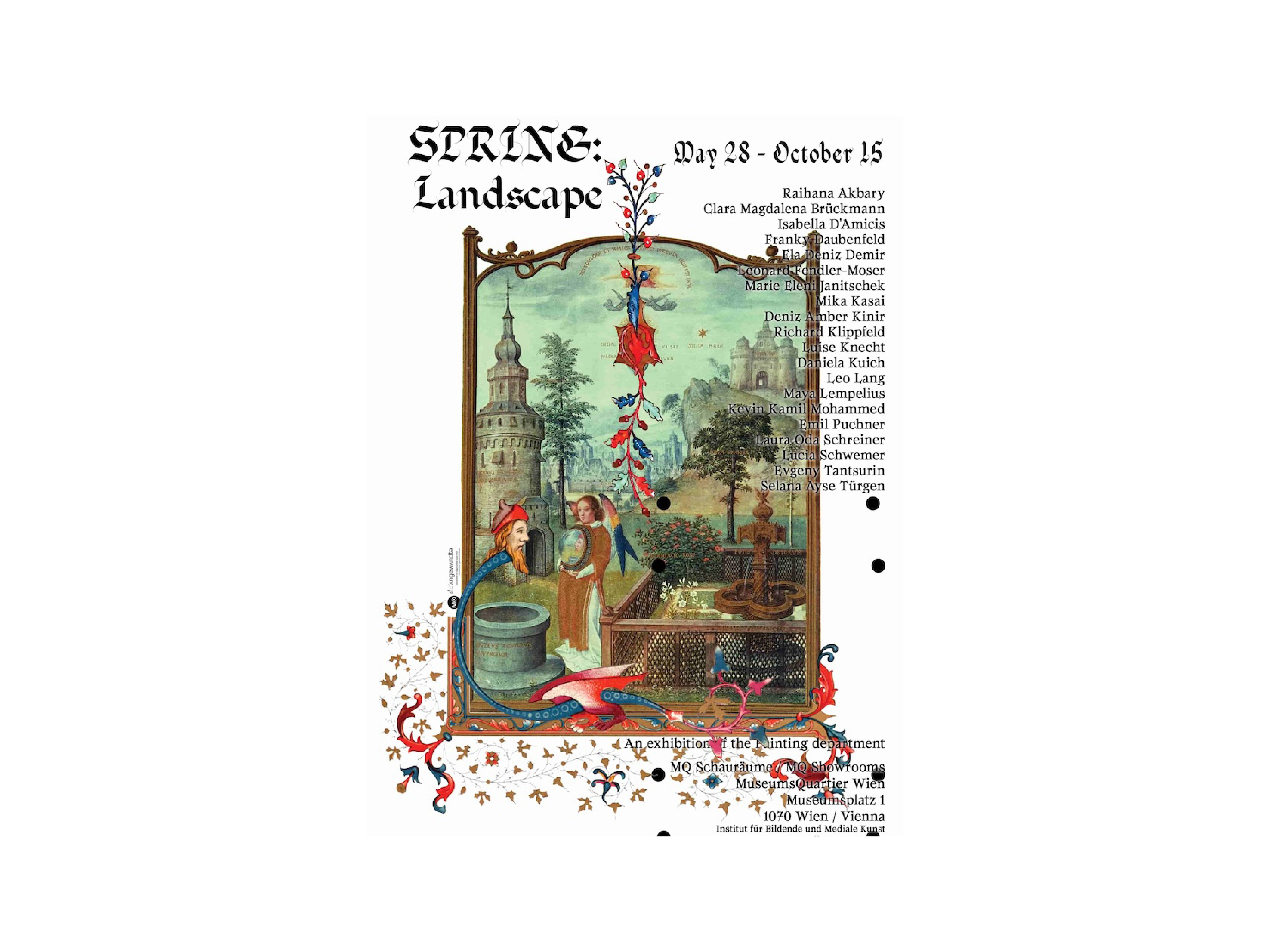
Spring
arrives like a correction that does not ask permission.
The light returns too cleanly, too insistently, as if nothing
had ever broken. Streets warm themselves, trees rehearse their leaves again, and the world resumes its surface level continuity
with a kind of practiced innocence.
But landscape has never been innocent!
In painting, landscape begins where the interior gives up its containment. The still life held things close, flowers cut and
disciplined, fruit arranged into quiet moral order, books resting in a suspended domestic timing. Landscape lets go of this
closeness. It releases the object into distance, and with that distance comes ideology.
What looks like openness
is already structure. What looks like nature is already a decision about how to see.
W.J.T. Mitchell writes
that landscpae is never just something we look at, but something that organizes looking itself. It is a cultural practice,
not a view. A medium that naturalizes its own authority by appearing to be outside history. In that sense, landscape does
not represent the world; it produces a version of the world that can be possessed from a point of view.
This
is where imperial logic enters quietly, almost gently. Because landscape painting often begins with beauty before it becomes
anything else. A horizon that seems endless. A sky that looks unowned. A distance that feels like freedom. But beneath that
softness lies a system of arrangement: territory made legible, space made measurable, land turned into image. The gaze that
enjoys the view is rarely neutral. It is positioned, centered, trained.
And yet what is most unsettling is
how easily this positioning disappears. The eye forgets itself. The image begins to feel like nature. And the structure survives
not as violence in the visible sense, but as calmness, as composition, as balance. Even the idea of "landscape" carries this
quiet afterlife of possession, something seen from a safe distance, something held in the frame.
We inherit these
ways of seeing long before we notice them as historical. Later thes return in softer forms: in films, in digital environments,
in game worlds designed to be moved through alone. Vast terrains rendered with care, with patience, with a strange tenderness
for emptiness. Forests that wait. Mountains that repeat themselves. Horizons that never fully close.
There
is a particular loneliness in these constructed landscapes. Not dramatic, but procedural. A world that continues only as long
as it is being observed. A world that feels complete precisely because nothing interrupts it. It is here that the old imperial
dream mutates: no longer conquest in the literal sense, but total design. The desire to shape space so fully that nothing
in it resists interpretation.
Mitchell's point lingers here; landscape is a way of seeing that makes its
own conditions invisible. And what it hides is not only power, but the comfort of that power – the ease of moving through
a world that seems to have been prepared for you in advance.
Painting, placed back into this field, no longer
simply depicts landscape. It interrupts it. Or at least tries to. Each work in this exhibition carries a different relation
to that inherited structure: some close, some distant, some letting the image stabilize into beauty, other letting it fracture
into atmosphere or memory. Together they do not resolve the question of landscape; they keep it open, slightly unstable, as
something still being negotiated.
SPRING: Landscape begins from this tension: between beauty
and structure, immersion and control, nature and its long training as image. It does not try to escape the landscape, nor
to purify it. It stays within the discomfort of looking at worlds that feel open, and the systems that made them feel that
way.
Text by
Gregor DivinzenzAn exhibition by the Painting department, hallucinated
and illuminated by
Henning Bohl and
Florian Pfaffenberger.
With
Raihana
Akbary, Clara Magdalena Brückmann, Isabella D'Amicis, Franky Daubenfeld, Ela Deniz Demir, Leonard Fendler-Moser, Marie Eleni
Janitschek, Mika Kasai, Deniz Amber Kinir, Richard Klippfeld, Luise Knecht, Daniela Kuich, Leo Lang, Maya Lempelius, Kevin
Kamil Mohammed, Emil Puchner, Laura Oda Schreiner, Lucia Schwemer, Evgeny Tantsurin, and Selena Ayse TürgenMany thanks to the MuseumsQuartier, the University of Applied Arts Vienna, the Institute of Fine Arts and Media Arts, and
all of the Painting department's students and staff.
abteilungmalerei.uni-ak.ac.at
MuseumsQuartier Wien